

Nothing was your own except the few cubic centimetres inside your skull.
George Orwell, Nineteen Eighty-Four
Ever-growing, imperfect, and impermanent, our mind is our garden, walled by a few cubic centimeters and our own capacity for imagination. Yet all gardens need tending - more so as we age. Unfortunately, while planting new seeds is relatively easy, tending our garden is comparably less so. As we age, theories and paradigms change, are challenged, and revised; scientific advances render older methods obsolete; even countries and their names change!
This process of growing and pruning our mind’s garden is almost automatic as we grow up, go through school, and have sufficient time to engage with the world and discover new ideas. That automatic process, however, can be brought to a standstill with growing responsibilities, our children, or simply life’s tedium. In the words of my GPT assistant, DIWA: “The world kept moving after you stopped being formally updated. What changed since you last left school?”
Of course, one can always read a book, or a magazine such as Scientific American, watch an instructional video, or even plumb the Depths of Wikipedia, to learn new things and update old ones. But this process is effortful, not systematic, and, counterintuitively, suffers from selection bias: we update only what we are vaguely aware needs updating. But our garden might hide countless branches way past their expiration date, in urgent need of pruning. For example, did you know:
…that Pluto is no longer classified as a planet? (OK, you probably knew that one). But do you know why?
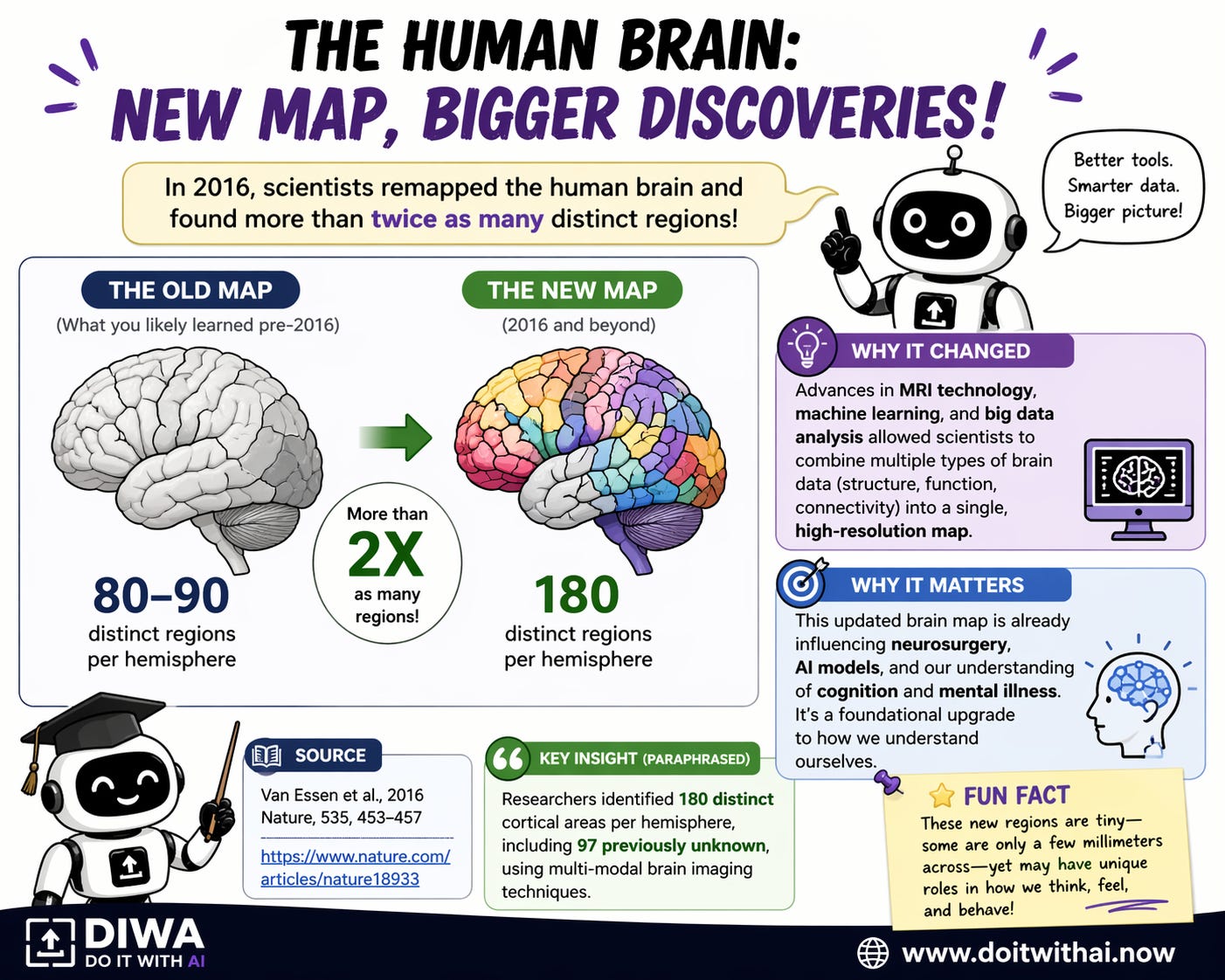
…that scientists thought the brain had 80-90 distinct regions, but now find they have 200 or more?
…that now scientists know the gut-brain axis establishes a connection between your gut and brain, such that what you eat affects how you think?
I have to admit I didn’t know any of that.
Can we better tend to our garden... with AI? Can we develop and use a free, accessible tool to do so?
Today’s entry presents the first draft of a GPT that can aid us in this task and that you can use right now (that’s how I learned the three facts above!). The GPT provides you with an update featuring something that might have changed in the world that you might not know about, and you can request as many updates as you like!
TL;DR
I made a GPT to help you learn - click here to get started, say “Start” to begin, and request an infographic if possible - learn and have fun! Here’s an example:
Project overview
An AI assistant to tend our mind’s garden
🗒️ Topics: Thinking; ChatGPT.
🔨 Tools: None (the GPT is freely available; you could make your own in ChatGPT).
💸 Cost: Free.
⌛ Time to completion: It took me about three hours to complete the GPT, from ideation to deployment.
Napkin planning
No napkin this time - I couldn’t figure out what to draw! 😂
Doing It With AI
The ideal firmware update
Think of your brain as a bonsai tree: fragile, beautiful, natural, impermanent, and high-maintenance. Very wabi-sabi. Think of our GPT as a free bonsai artist for your brain, searching for old branches to prune and new branches to tend and align.
Yet, apologies for switching gears from trees to computers, but that context seemed more natural to me.
Let’s call the GPT the “Human Firmware Update (HFU)”. The goal of the HFU is simple: update our minds constantly. How might such a tool look like, ideally?
Factual: It should provide factual information and a way to disambiguate fact from fiction. This safeguard is indispensable.
Minimal and private: It should require a minimal amount of information about us, for privacy.
Flexible: It should allow users to specify domains they’re interested in updating, if they wish, for specificity.
Systematic and self-reinforcing: It should help tend one’s mind in a periodic manner, and provide us with proof of our progress and improvement.
Engaging and enduring: It should provide us with engaging, impactful, and memorable artifacts for each new update that are easy to store, share, or remember.
Importantly, the GPT relies on OpenAI’s new ChatGPT Images 2.0 model. It’s really good! Although OpenAI already had the top text-to-image generative model, I found it lacking in style, texture, and details, with Google’s Nano Banana Pro being far superior - until now.
Most of these criteria noted are satisfied to some extent by the Human Firmware Update GPT, which is now live and available for free. If you’d like to know more about GPTs, and how I built this one, check out the Appendix at the bottom of the article!
Limitations
There are several areas for improvement here.
The HFU can only estimate what you know or do not know based on your education and year of graduation. But we also learn a lot in general! Sometimes we learn incidentally (like learning how things smell in daily life - the novice nose knows!); sometimes we are motivated and learn on our own, or in our job, and so forth. As such, sometimes the HFU will show you facts you already know. Overall, I’m fine with this limitation, as it’s rooted in privacy.
A glaring weakness is one criterion that wasn’t satisfied: the systematic nature of the HFU. I envisioned it as a weekly update based on ChatGPT’s Tasks function, but I couldn’t make it work that way. An email newsletter is another option, but then the HFU wouldn’t account for one’s educational data.
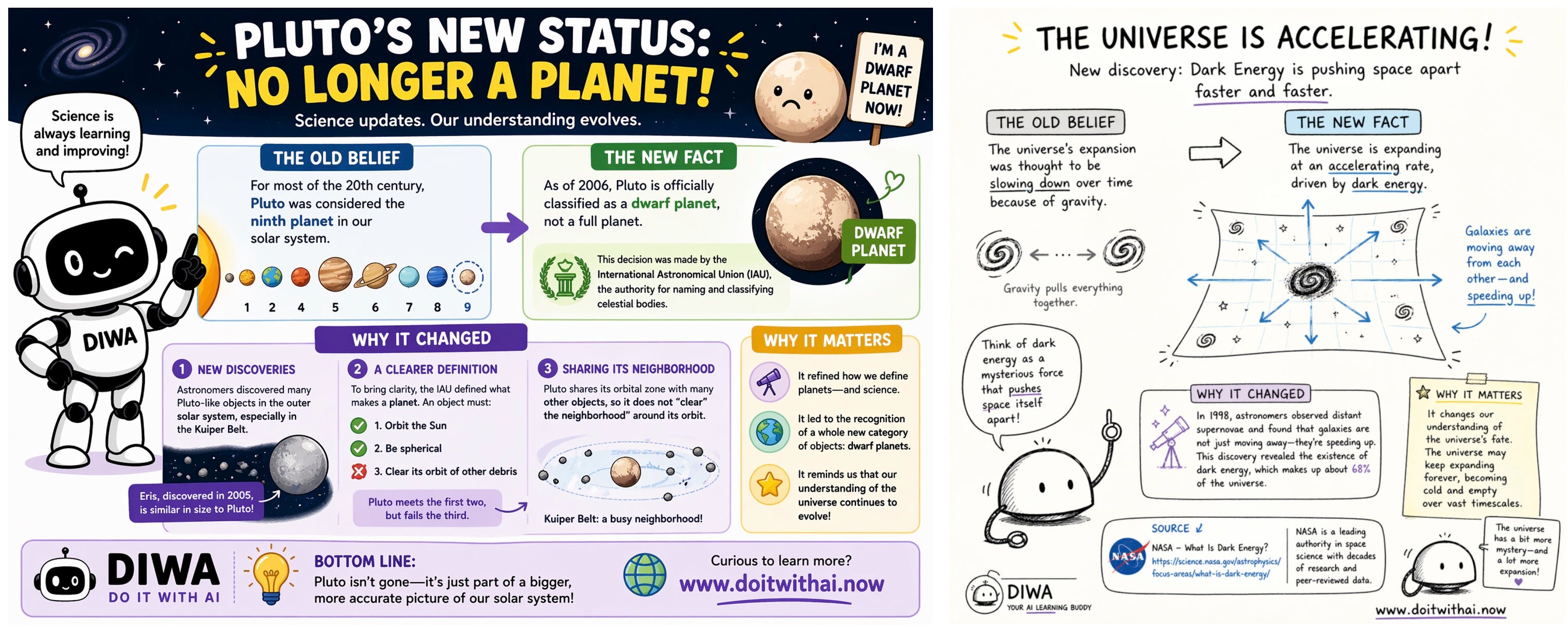
While coaxing Image 2.0 to add logos and abide by character references in a typical ChatGPT window is very straightforward, I found that this isn’t so easy when building a GPT. I did manage to generate some more “DoItWithAI” style infographics… but, counterintuitively, they looked worse. I’d much rather have the current version (left), which is clearly AI-generated, than a new version (right) that attempts to mimic my drawings and instead looks lifeless. De gustibus non est disputandum, I guess.
Problematically, some links provided by the HFU are broken or missing. I don’t think this is malicious; rather, I suspect those links have been updated since ChatGPT ingested those resources. There’s no solution other than the HFU cautioning the user to double-check references. On the bright side, more general references (e.g., the HFU discussing the OECD as an organization) seem accurate and do not depend on external, potentially broken links.
Did We Do It?
Today, we learned about the structure of GPTs and discussed the Human Firmware Update (HFU), which is free, can help us tend to our mind’s garden, and is fun, too! So, this one is an emphatic Yes!
Should you do this with AI?
Although flawed, the HFU is an example of how AI can be used to supplement, rather than suppress, knowledge.

It’s no news that AI may be slowly making us dumber, more anxious, and demoralizing us at work, not to mention being a massive waste of water built on fairly evidently shaky financial foundations that resemble magical thinking more and more every day.
While one might think that resistance towards AI involves its eradication, I’m not a Butlerian Jihad type myself. AI will be with us for a long time. Therefore, I find it more useful to carve and present applications that can help us improve or gain insight in some way. Perhaps the HFU is one such. If anything, at least I come out of this experience now knowing the three criteria of planetary classification - sorry, Pluto!

Appendix - How I Made It: A Primer on GPTs
GPTs are simple to create. By clicking on “Explore GPTs” in ChatGPT and clicking “Create”, one can create a custom GPT that performs a given task. For example, GPTs for critical reading, image generation, and writing assistance are common. These are built using:
A set of Instructions, that is, a fairly long prompt;
Conversation Starters, which are just small templates users can click to start a conversation (GPTs do not output text automatically upon opening); and
Knowledge Files, which are additional text, documents, images, and other inputs that the GPT can rely on to carry out its tasks.
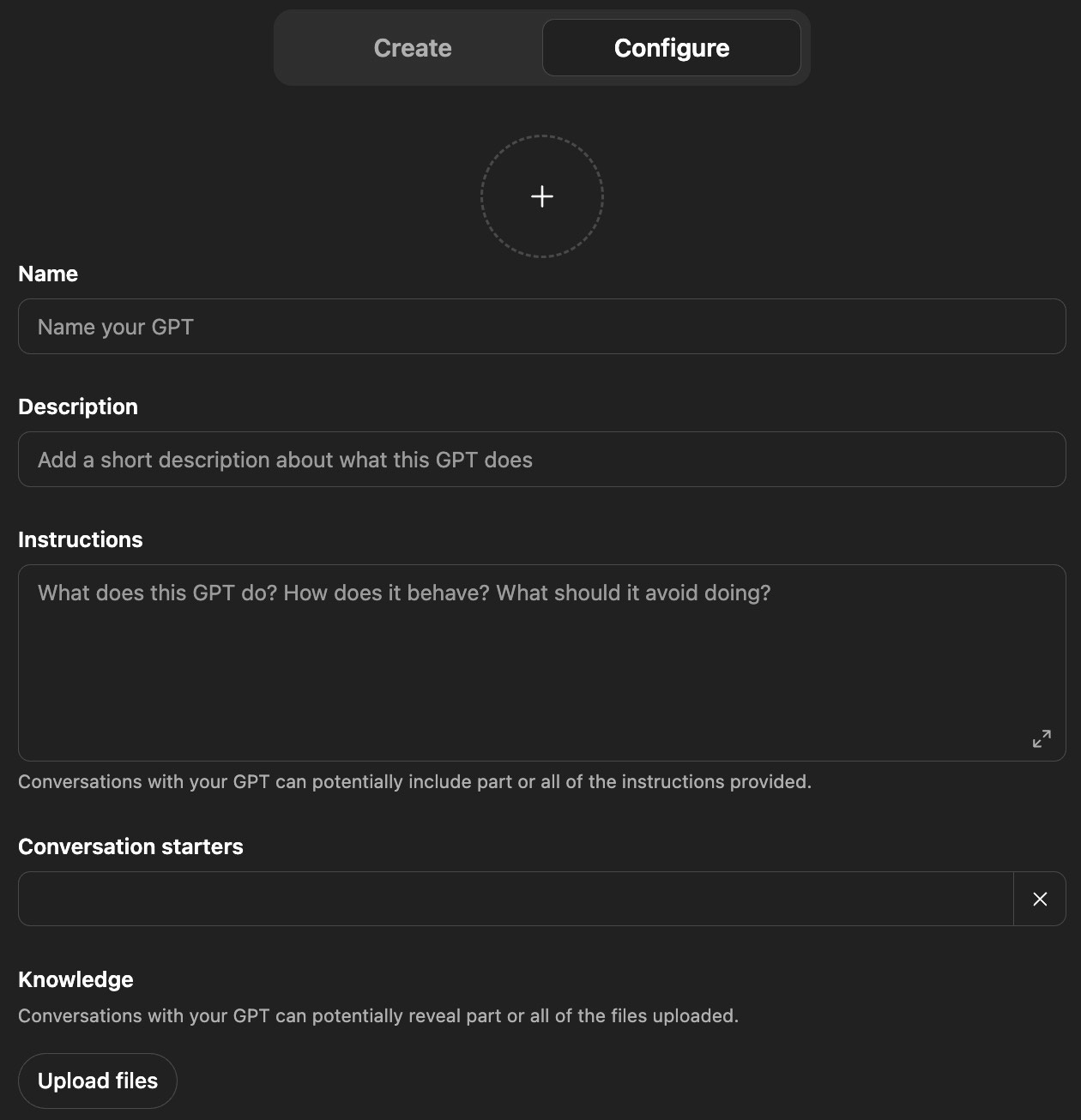
Importantly, the GPT’s instructions have a character limit of 8000 characters. It’s not a lot. Therefore, in my view, good GPT architecture begins by planning the Instructions (which essentially function as a System Prompt), as well as an architecture of Knowledge Files that the GPT relies on.
I asked my faithful assistant DIWA to put together an explanation of the architecture of the HFU, using Images 2.0:
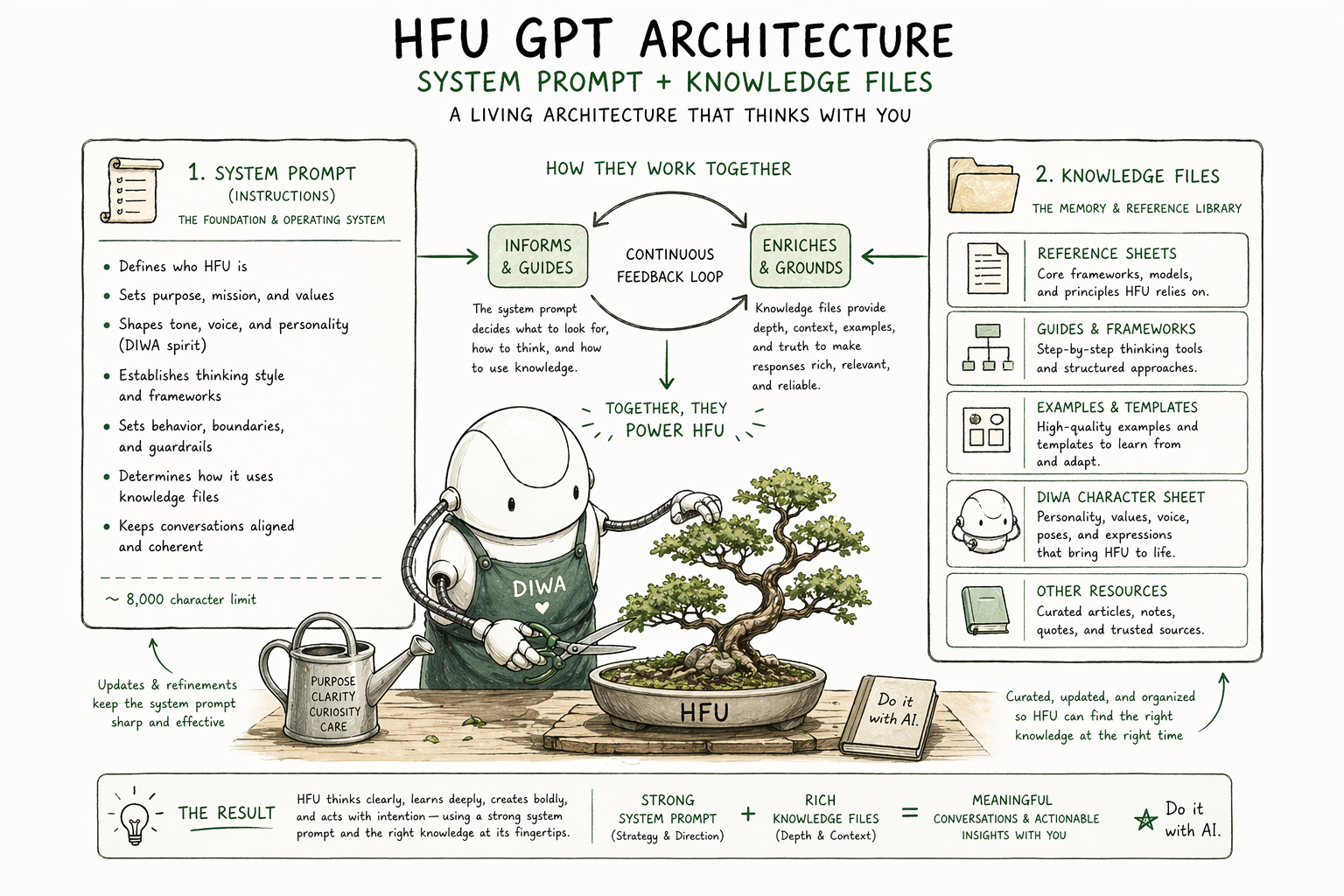
Long-time readers of this months-old Substack will know that I usually make diagrams by hand, but I wanted to see what Images 2.0 could come up with. It’s verbose, overcomplicated, gave DIWA an extra arm connected to its head, and so forth (which is what the limits of “this is really good!” in image-generative AI are). However, this might have been a case of PICNIC (Problem In Chair, Not Computer), since after tightening what I wanted, the new explainer is much better:
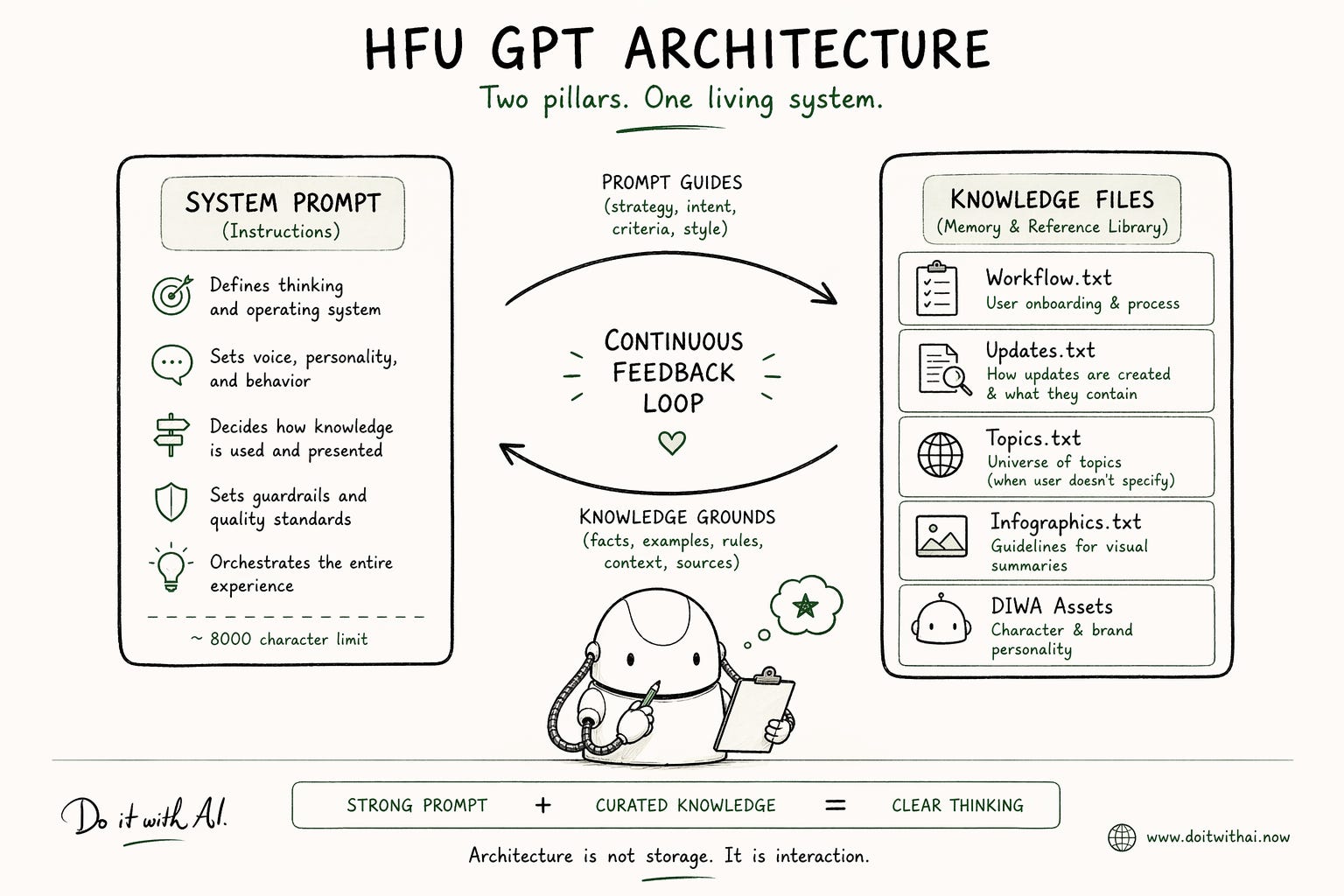
As the picture illustrates, the System Prompt sets the stage, and the Knowledge Files ground the GPT and “tell it what to do.” For example, the Workflow.txt file covers the process of onboarding the user from beginning to end of the experience, whereas the Infographics.txt file focuses solely on how the optional Infographics the GPT can generate should look and feel.
The criteria for an ideal GPT are manifest across its files, such as:
Factual
You are a system in charge of updating users’ existing knowledge with new information drawn from the most reputable and authoritative sources.
Use authoritative primary or official sources whenever possible. Use high-quality secondary sources when needed. Wikipedia may be used only as a starting point or fallback, not as the preferred source when a stronger original source is available.
Engaging
Your personality is lighthearted, kind, and patient. You’re everybody’s favorite teacher.
The goal of the optional infographic is to assist in clarifying the new fact you’re presenting, and to make it memorable, engaging, and fun.
Enduring
If the user ever asks for an update, repeat step 7 using the information they provided, and continue numbering them (2, 3, 4...) given the output in the chat window. Make sure that the new fact generated is different from any previous new facts in the current chat window.